
A simple guide to business energy bills - and how to reduce costs
In this article:
5 min read
Michael Potts
:
Jun 2, 2026 10:00:00 AM
In this article:
Learn about business energy tariffs, suppliers and what affects prices.
Understand what you're actually paying for on your bill.
Discover simple ways to reduce your business energy costs.
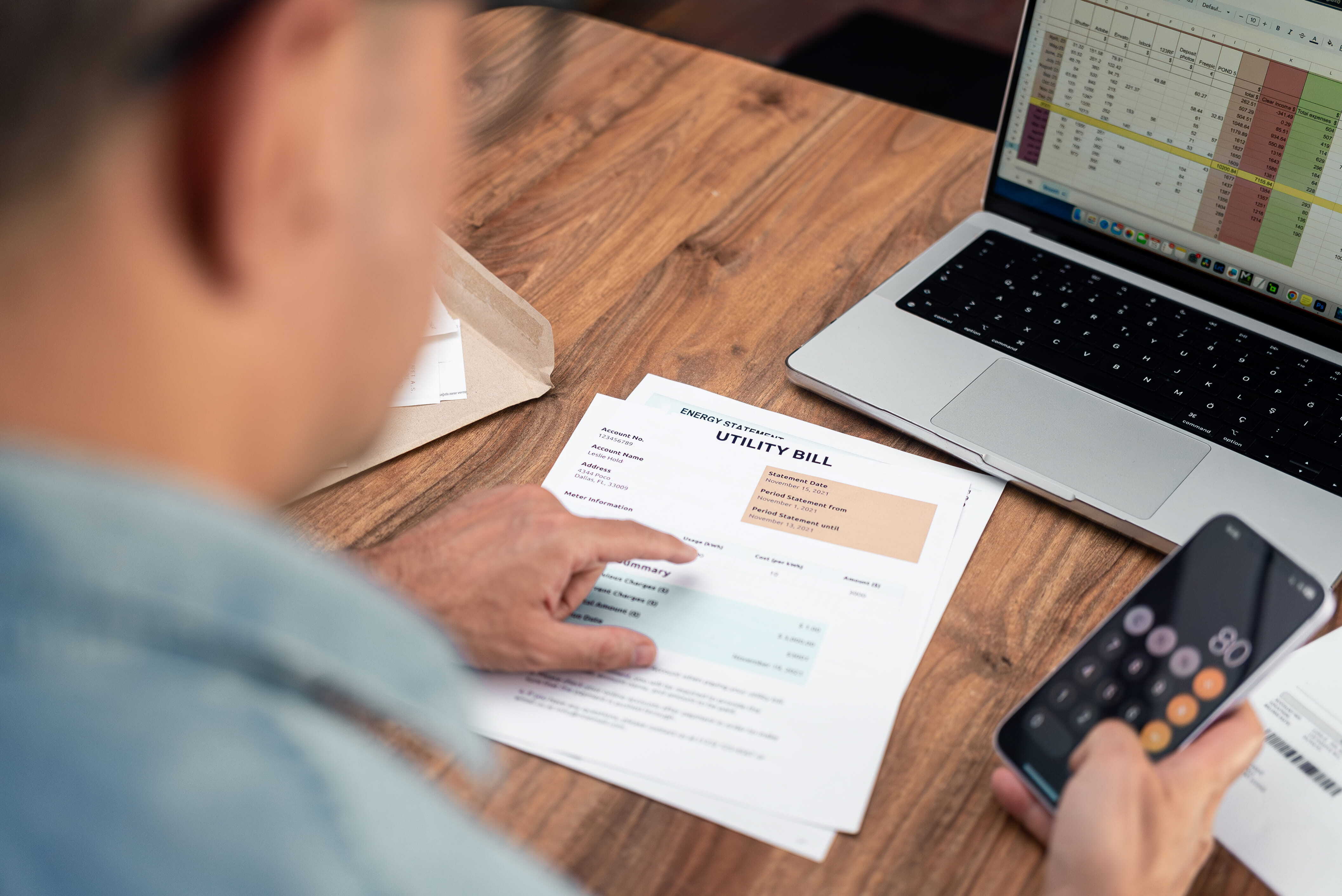
You didn't go into business to wrestle with energy bills. Finding the right supplier, choosing between fixed and flexible contracts, and keeping up with rising prices can feel like a lot. We know.
Nearly three in 10 UK businesses reported struggling with their energy bills in 2025, according to research by Ofgem, the UK energy regulator.
UK businesses pay more for their industrial energy than any other member of the International Energy Agency (IEA) where data is available, according to the Department for Energy Security and Net Zero.
In 2026, global tensions and market volatility triggered more pressure on UK business energy costs - another thing to deal with on top of serving your customers every day.
That's why we have created this simple guide to business utilities, including gas, electricity and water.
Whether you're a small start-up or a larger established company, knowing the basics can help you improve stability, make smarter decisions and reduce costs in an uncertain world.
There are lots of different types of business energy tariffs, ranging from stable fixed contracts to variable rates that change throughout the course of your deal.
The most popular tariffs are:
Fixed-term contract: The price of a unit of energy - measured in kWh (kilowatt-hour) - will not change for the duration of your contract. Your monthly bill may go up and down each month depending on usage, but the price per kWh is locked in.
Who is it for? Businesses that prioritise stability.
Pros: No matter what happens in the world, if you’re under a fixed-term contract, your prices will not rise.
Cons: If energy prices fall, you will continue to pay the unit rate you signed up for.
Variable-rate contract: The price of a kWh of energy could rise or fall depending on the markets. Most variable-rate contracts operate on a rolling basis as opposed to a fixed length of time.
Who is it for? Businesses that can tolerate risk.
Pros: If market conditions improve, your unit rate will drop and your monthly bill will go down.
Cons: If market conditions worsen, or an energy shock hits, your unit rate will rise and your monthly bill will go up.
Other examples of business energy tariffs include:
Flex approach: Bulk buy energy in advance at competitive market rates.
Pass through: Certain elements of your energy bill can be fixed or variable.
Time-of-use: A fixed contract with two unit rates for off-peak and peak times.

Understanding your energy bill is the first step towards knowing whether you’re on the right deal for your business. Here are some key terms to help:
Standing charge: The daily fee you pay to have energy supplied to your premises.
Unit rate: This is the cost of the energy you use, measured in pence per kilowatt-hour (kWh).
Contract length (term): This is how long your agreement lasts.
Out of contract rates: These are the (usually much higher) charges you’ll pay if your contract ends, and you don’t agree on a new one.
Termination notice period: This is the amount of time you need to let your supplier know if you want to leave your contract.
Early termination/exit fees: If you leave your contract before the agreed term ends, you could face charges.
Pass-through costs: These are charges added to your bill for things like network maintenance and government levies.
Metering costs: Your contract might include fees for installing or maintaining your energy meter.
Billing type (estimated vs. actual): Your energy bill may be based on estimated readings if your meter isn’t regularly updated.
VAT and other taxes: Most businesses pay VAT on energy at 20%, but some may qualify for a reduced rate of 5%.

Just over one third of your energy bill pays for the electricity, gas and water fuelling your business.
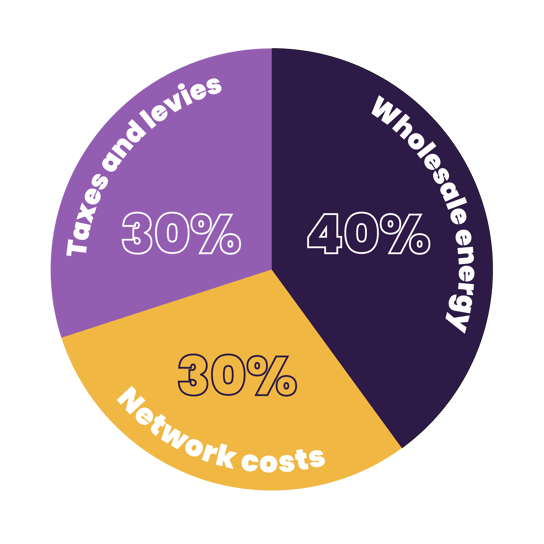
You pay your bills on time every month... but do you know what you’re actually paying for?
40% - Wholesale energy: The cost of the energy you need.
30% - Network costs: Charges to fund the operation and maintenance of the national electricity grid. Known as transmission and distribution costs.
30% - Taxes and levies: Charges imposed by the government to support environmental policies, schemes and initiatives, plus VAT.
A variety of factors can affect business energy prices, including geopolitical events, government policy changes to taxes and levies, global supply chain shocks and yes, even the weather.
The price of wholesale energy is sensitive to supply and demand factors. For example, if the Strait of Hormuz is closed or critical infrastructure is not operational, supply is reduced but demand remains the same. The price of wholesale energy will rise.
If the next Beast From the East hits and Britain experiences an unusually cold month, homes and businesses will dial up the heating, leading to higher demand but supply remains the same. Again, the price of wholesale energy will rise.
However, focusing too much on the headlines can cause confusion. As explained above, wholesale costs tell less than half of the story.
The government makes a choice when they apply taxes and levies to a unit of energy – and when they raise them to fit in with their priorities.
Businesses may also be offered incentives in the form of a lower VAT rate or removal of an environmental levy if they use less energy, move away from fossil fuels or adopt specific forms of renewable energy.
Are you ready for some bad news? Your bill doesn’t just feel high – it is.
Recent energy shocks arising from the Russia-Ukraine conflict and US-Iranian tensions particularly affect British wholesale costs due to the fact 26.5% of our electricity was generated using gas in the 12-month period from May 2025.
Yes, that's right: when the price of gas rises, the price of electricity rises with it.

But remember, wholesale prices don’t give the full picture. Non-commodity costs have soared in recent years.
Since 2015, the non-commodity portion of an energy bill has risen from around 35-40% of a business energy bill to around 60% - and that is despite much higher wholesale costs.
Charges are rising to pay for new infrastructure, including cables to connect renewable sources such as wind turbines, to the national grid for transportation around the country.
There is no such thing as a ‘best’ business energy supplier. The right supplier depends on your specific operations and needs. And you have a greater choice than you may think.
You might have heard of the 'Big Six' energy suppliers:
British Gas
EDF Energy
E.ON
Npower
ScottishPower
SSE
In 2008, they supplied over 99% of UK domestic and small business customers between them, but new challengers emerged to reshape the landscape.
Ovo Energy took over SSE’s list of customers in 2020, while E.ON Next absorbed Npower into their business and Octopus Energy powered their way through the industry to become the single largest energy supplier in the UK with around 25% market share alone.
The new Big Six still dominates the landscape with around 90% of domestic and small business customers, but there are plenty of smaller companies gaining ground.
Troo works with more than 25 suppliers of all sizes to provide the most suitable service for businesses across the UK.
Short of picketing Downing Street and asking the Prime Minister and their Energy Secretary to slash taxes and levies, there’s not much you can do about the non-commodity side of your bill.
However, there are three fundamental ways you can reduce your business energy costs:
Find the right deal: Understanding your bill, what your term is and how much you’re paying per unit is a crucial first step.
Boost your efficiency: Using less energy - and using energy smarter - means you can start bringing down your costs today.
Weigh up renewables: Wind power is now the biggest source of energy generation in the UK, around a third, while solar power is becoming increasingly popular for businesses to generate energy on-site.
You’re busy. We get it. Finding time to simply read an energy bill is tough enough - and that’s before you consider whether it’s a good bill.
Troo exists to help businesses like yours make sensible energy decisions in a topsy-turvy world, from finding the right deal, assisting with efficiency savings and working on renewable solutions.
We are on hand to offer more quick, practical guidance when you book a free energy health check today. We’ll review a recent bill, talk through your setup and kit list, and discuss quick wins plus longer-term upgrade ideas.
In this article:
The UK energy market is changing - again. In this article:
The energy industry is going to start asking for more from businesses like yours. In this article: