2 min read

May Energy Market Update

May Energy Market Update
2:15

Market news

Energy markets continue to be dominated by escalating and unresolved geopolitical risk in the Middle East, with the Strait of Hormuz remaining the central structural concern.

Price volatility has continued throughout April driven by on-off peace talks and political rhetoric. Currently, diplomatic progress has stalled but this can change quite quickly.

However, market focus has shifted away from short term headlines toward the duration of disruption, infrastructure damage, and long-term LNG supply losses, fundamentally tightening the global gas outlook into the late 2020s according to the latest International Energy Agency analysis.

Key market drivers during period

Key market driver What happened Price influence
Geopolitical tensions:
Iran re-closed the Strait of Hormuz, continuing the disruption of global oil and LNG flows. 
UP
Commercial vessels were fired upon; the US seized an Iranian flagged ship.
UP
Confidence in energy transit through Hormuz has been materially damaged.
UP
Initial ceasefire hopes faded as Iran withdrew from US led talks.
UP
The US later cancelled planned diplomatic engagement in Pakistan.
UP
A ceasefire is in place but remains fragile with peace proposals been rejected by both parties.
UP
Markets increasingly see resolution taking months not weeks.
UP
Supply & Storage:
Storage Levels: EU: 35%, injection rates are currently below last year’s levels.
UP
Carbon market movements:
UK Dec 26 carbon contracts are steady, trading around £53 after hitting lows of £35 in March.
UP
Global supply/demand:
IEA estimates the conflict could remove ~120 bcm of LNG supply for 2026-2030.
UP
~20 bcm already lost since late February due to shipping paralysis.
UP
Damage at Qatar’s Ras Laffan LNG complex has destroyed 17% of export capacity, with repairs taking up to 4 years.
UP
New projects and expansions delayed, removing a further ~20 bcm from forward supply.
UP
Bank and consultancy analysis highlights that even with a reopening of Hormuz:
UP
Crude flows would normalise over ~1 month.
 
Refined products could take up to 6 months.
 
Natural gas flows may require up to 12 months.
 
Physical repair timelines, not diplomacy, are now the binding constraint.
 
Non-commodity costs:
Non-commodity costs set to rise through the 2030’s driven by Transmission and green levy increases.
UP
New Wholesale Contracts for Difference proposals been reviewed by UK Govt. to assist in decoupling gas from being the price setting generator in the UK Markets.
UP
Supply & Storage:
Storage Levels: EU: 35%, injection rates are currently below last year’s levels.
UP
Carbon market movements:
UK Dec 26 carbon contracts are steady, trading around £53 after hitting lows of £35 in March.
UP
Weather:
Temperatures forecasted to be around seasonal averages in the near-term reducing demand.
DOWN

Outlook

What began as a short-term geopolitical shock is now locking in multi year LNG supply losses, prolonged shipping risk, and lasting damage to confidence in global energy transit.

Price formation is no longer driven primarily by weather or storage, but by geopolitical duration, infrastructure repair timelines.

The balance of risk therefore remains on the upside with limited downside forecasted, and heightened volatility into winter and beyond.

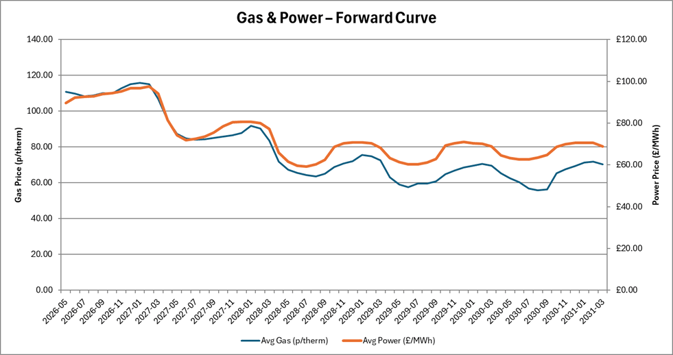
Currently market prices after 2026 and early 2027 remain lower (backdated) and have not seen the same impact as the near term.

However, the longer the conflict continues we may see sentiment shift from the 2026 period into Summer and Winter 2027 and longer dated contracts.

Key risk messages

  • Structural supply issues - Lost LNG volumes, especially from Qatar, cannot be replaced quickly.

  • Low storage levels - EU storage is sitting around 35%, well below last year.

  • Ongoing volatility - Prices are moving sharply week-to-week.

  • Rising non-commodity costs - With higher transmission cost and other green taxes increases expected through 2030.

  • Analysts do not see wholesale prices dropping significantly in 2026 even if the conflict is resolved with expectation they may rise further with market analysts modelling gas prices in the £38 - £70MWh (3.8p - 7pKwh) for this year depending on the duration of conflict.

Market data

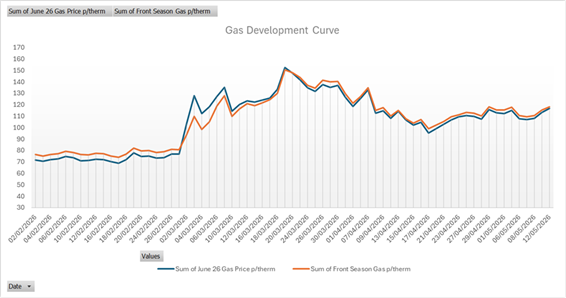
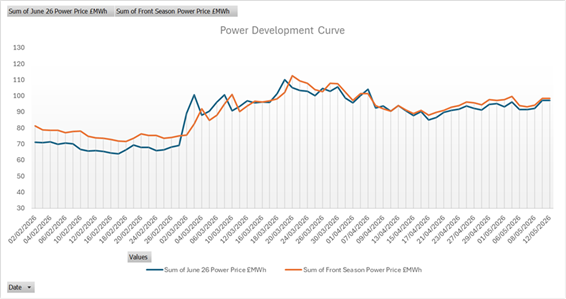
The impact of the US-Iran conflict can be seen from the end of February.

Gas

MU May Gas

Power (Electricity)

MU May Power

Wholesale forward price curve

MU May Forward


May Energy Market Update

May Energy Market Update

Market news Energy markets continue to be dominated by escalating and unresolved geopolitical risk in the Middle East, with the Strait of Hormuz...

Read More
Is your dry cleaning business ready for changing demand? Your 13-point checklist

Is your dry cleaning business ready for changing demand? Your 13-point checklist

It’s the start of a new week and the loads are piling up.

Read More
How demand for dry cleaning is changing – and what you can do about it

How demand for dry cleaning is changing – and what you can do about it

Most commercial dry cleaners could forecast what items would land in their machines during any given week.

Read More